Dynamic Visual–Inertial Odometry

STAG-VIO

Stabilized Prompt-to-Geometry Interface for Robust Dynamic Visual–Inertial Odometry.

Track-to-Prompt Prompt-to-Mask Mask-to-Geometry

Rui Zhou1 · Jingbin Liu2,† · Junbin Xie1 · Jianyu Zhang1 · Yingze Hu1 · Jiele Zhao1

1Electronic Information School, Wuhan University    2College of Geodesy and Geomatics, Shandong University of Science and Technology    Corresponding author

IROS 2026 Logo
Accepted to IROS 2026
SCROLL ▾
0%
Median ATE ↓ via prompt stabilization
0%
RMSE ↓ in real-world urban traffic
0%
Speedup via safe encoder reuse
0
No VIODE sequence failure
Project Video
Abstract

Stability beats capacity

Dynamic visual–inertial odometry (VIO) requires reliable suppression of motion-corrupted measurements, yet prior semantic-assisted approaches depend on category-limited segmenters and degrade under partial occlusion. Promptable foundation segmentation models offer category-agnostic dynamic parsing, but their effectiveness in VIO depends critically on the temporal stability of input prompts — a factor largely overlooked in existing pipelines. When prompts derived from raw detection are jittery or intermittent under occlusion, the resulting masks flicker across frames, destabilizing geometric estimation.

We propose STAG-VIO, which formulates dynamic robustness as a perception-to-geometry interface stabilization problem. We introduce uncertainty-adaptive multi-object tracking that models prompt generation as state estimation with bounded noise adaptation, producing temporally coherent box prompts. These stabilized prompts drive a lightweight foundation segmenter whose masks undergo geometry-oriented morphological refinement to establish conservative safety margins. A constraint-budget-aware feature redistribution strategy preserves well-conditioned static measurements when dynamic regions dominate the view.

Experiments on VIODE and OpenLORIS-Scene show consistent gains over state-of-the-art baselines. Ablation confirms that prompt stabilization is the single most impactful component, reducing trajectory error by up to 83%.


Method

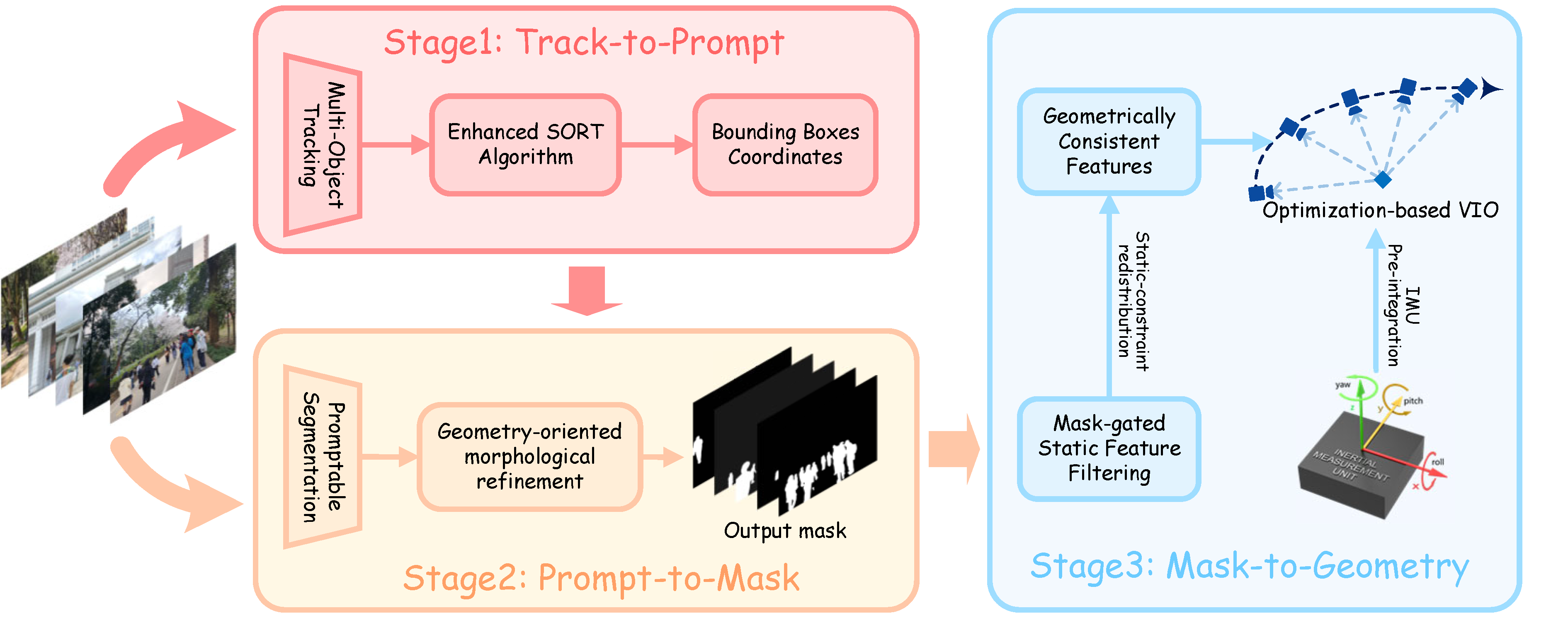
Three stages, one stabilized information chain

Noise introduced at any stage propagates and amplifies downstream: jittery detections → flickering prompts → inconsistent masks → corrupted geometric constraints. STAG-VIO inserts an explicit stabilization mechanism at every transition of the chain Dt → B̂t → Mreft → Pstatict → xt.

Stage 1

Track-to-Prompt
Uncertainty-Adaptive Tracking

Prompt generation is modeled as state estimation with bounded noise adaptation. A constant-velocity Kalman filter with an erf-based, asymmetric trust mechanism adapts the measurement noise R from innovation statistics: trust consistent detections, downweight deviant ones — bridging detection gaps under occlusion.

Stage 2

Prompt-to-Mask
Geometry-Oriented Refinement

Stable prompts drive a lightweight promptable segmenter (MobileSAM). A deliberately conservative “heavy-dilate, light-erode” refinement over-envelopes moving objects, keeping motion-blurred edge features out of the estimator — while temporally coherent prompts enable safe encoder embedding reuse for a 23% speedup.

Stage 3

Mask-to-Geometry
Constraint-Budget Redistribution

Mask-gated feature filtering removes corrupted residuals, then ANMS-based redistribution replenishes spatially well-distributed static features up to a target budget — keeping visual–inertial optimization well-conditioned even when dynamic regions dominate the view.

STAG-VIO pipeline overview
Experiments · VIODE

Graceful degradation, not catastrophic collapse

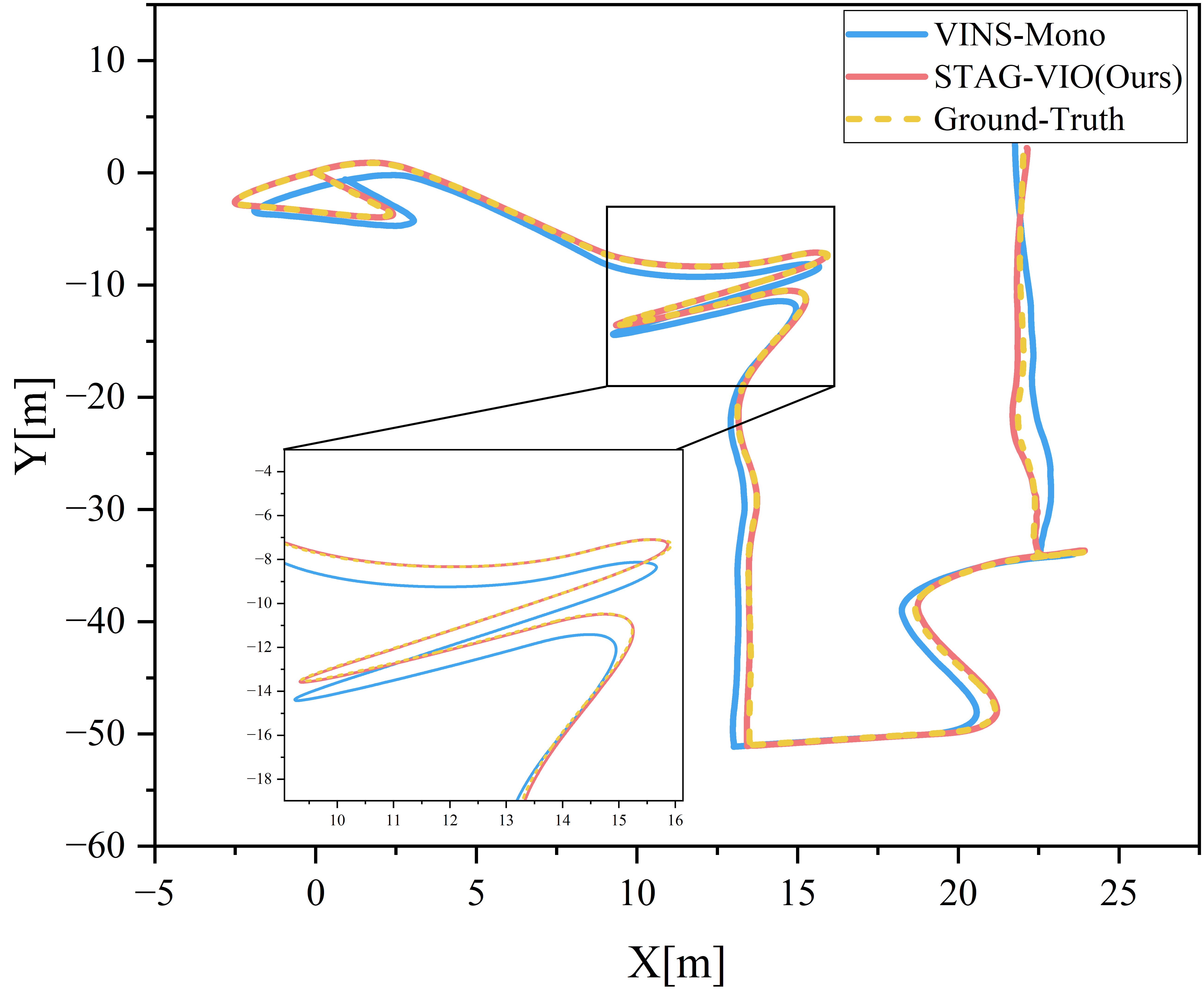
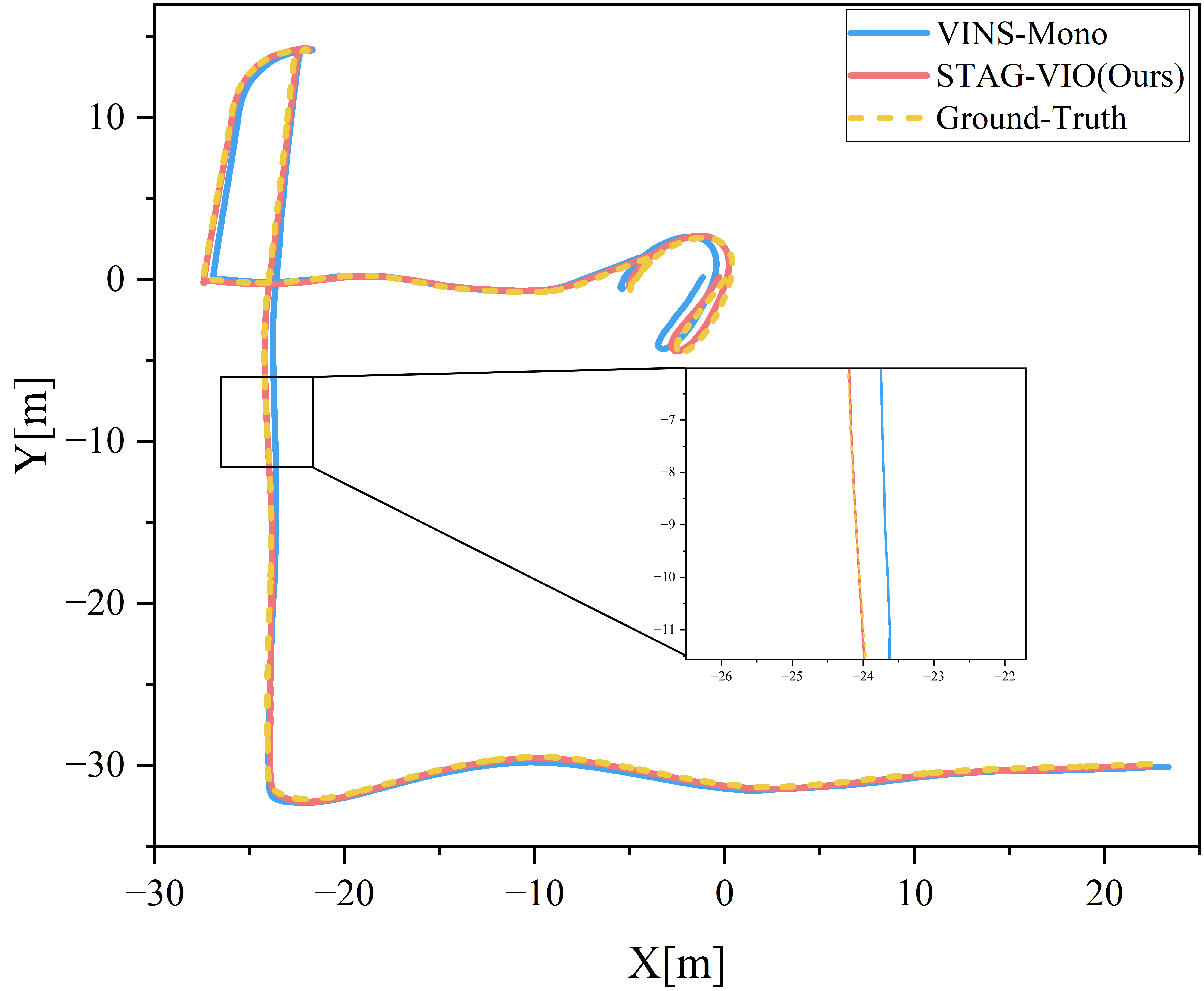
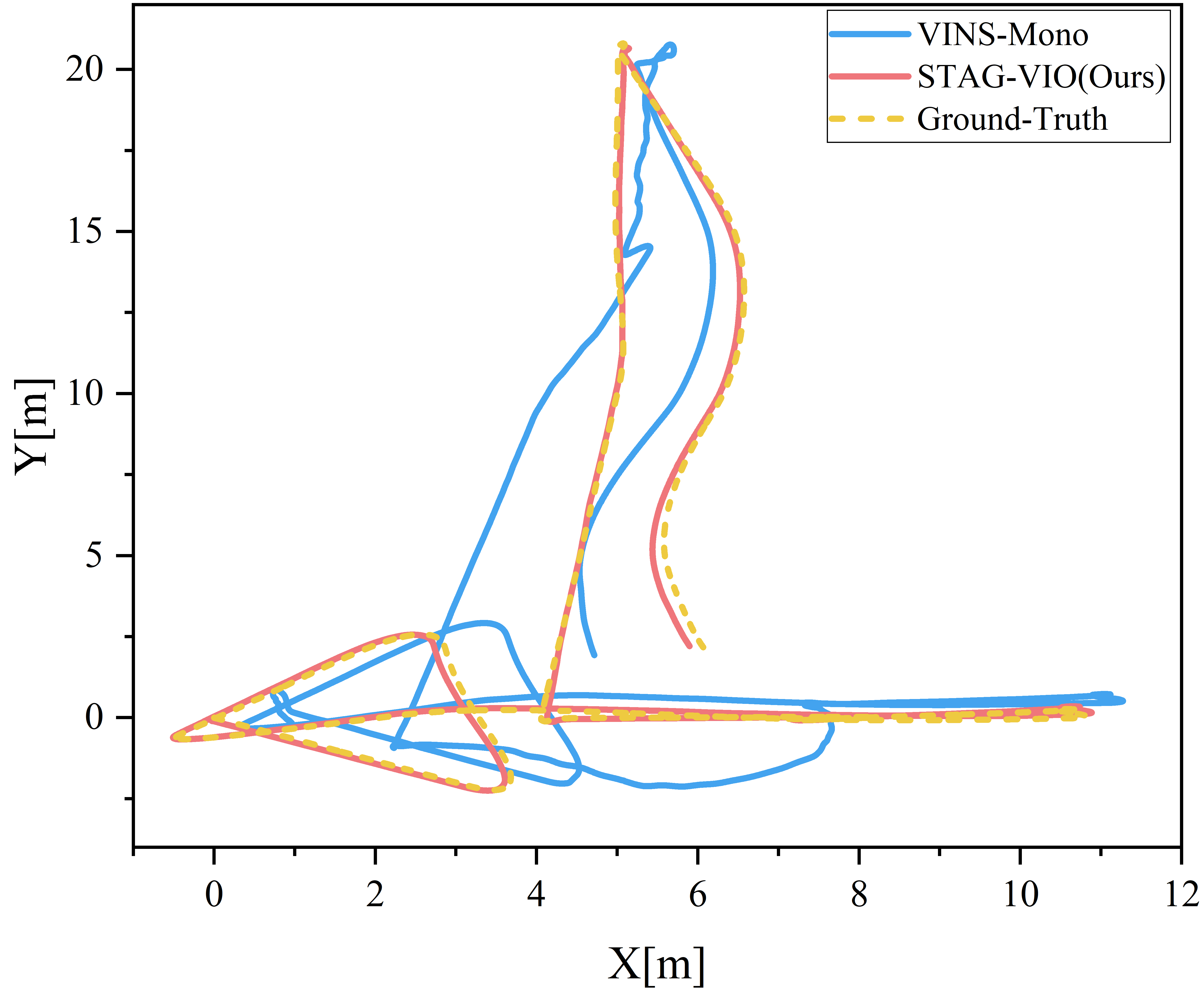
Across the full none→high dynamic sweep, STAG-VIO stays within 0.094–0.246 m ATE in every environment — a spread under 2.2× — while every baseline exhibits at least one catastrophic failure or divergence.

ATE RMSE [m] on VIODE — best per column highlighted · * failure case
Method City day City night Parking lot
nonelowmidhigh nonelowmidhigh nonelowmidhigh
ORB-SLAM32.1795.3012.204*0.176***0.2872.8976.7427.482
VINS-Fusion0.2030.1480.2610.3210.3190.3680.4330.4900.1200.1130.1611.201
VINS-Mono0.1860.2370.2633.1690.3140.4360.7270.5750.1020.1092.9154.933
VINS-Mah0.1490.1930.2220.2640.4170.6100.6510.5560.1360.1510.2460.128
RP-VIO0.3820.2290.4350.5360.2630.5090.6520.5770.9811.3340.3750.713
RD-VIO0.3050.1480.1871.2210.3050.8710.6350.5600.2990.3590.3120.527
Dyna-VINS0.3490.3300.2580.2450.6870.2070.2510.3110.1060.1670.1810.105
STAG-VIO (Ours)0.1070.1560.1380.2040.1250.2460.2220.2100.0990.1600.2040.094
STAG-VIO never fails and never exceeds 0.246 m ATE in any configuration, including the most adversarial high-dynamic sequences.
VIODE City day high-dynamic trajectory comparison
City day · high dynamic
VIODE City night high-dynamic trajectory comparison
City night · high dynamic
VIODE Parking lot high-dynamic trajectory comparison
Parking lot · high dynamic
Experiments · OpenLORIS-Scene

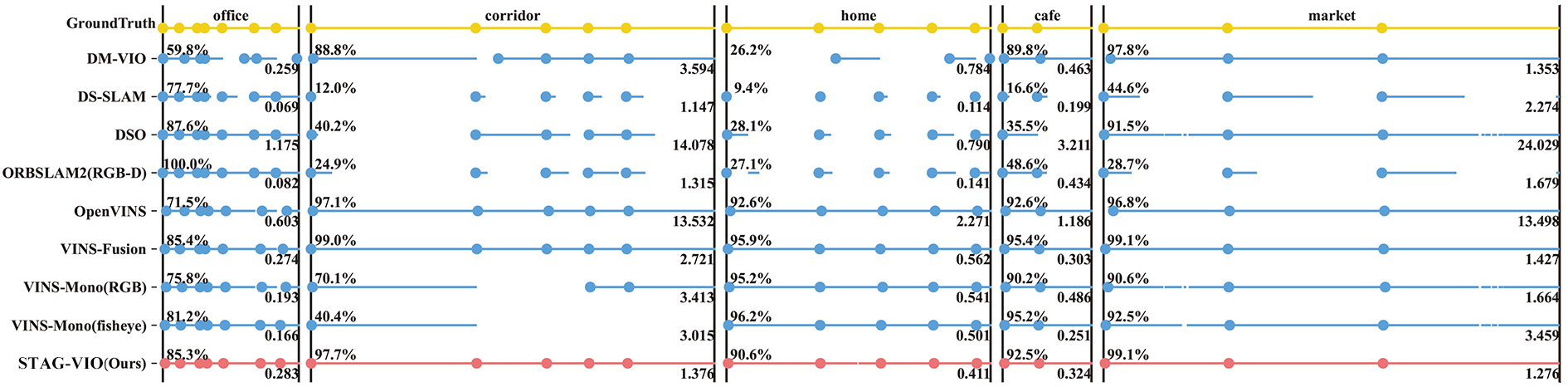
Long-horizon robustness in open-world indoor scenes

OpenLORIS-Scene · open-world indoor

99.1% CR
MARKET — DENSE CROWDS, PERVASIVE OCCLUSION

Across long-horizon everyday environments, STAG-VIO sustains 99.1% correct rate in market (1.276 m ATE) and 97.7% in corridor (1.376 m ATE) — the two most demanding scenes, where fixed-vocabulary baselines lose tracking as unseen or heavily occluded objects evade their segmenters. High CR paired with bounded drift is the deployment-relevant outcome: sustaining tracking through heavy dynamics, rather than terminating early.

OpenLORIS-Scene experiment results comparing correct rate and ATE RMSE across office, corridor, home, cafe, and market scenes
OpenLORIS-Scene results across office, corridor, home, cafe, and market sequences
Experiments · Ablation

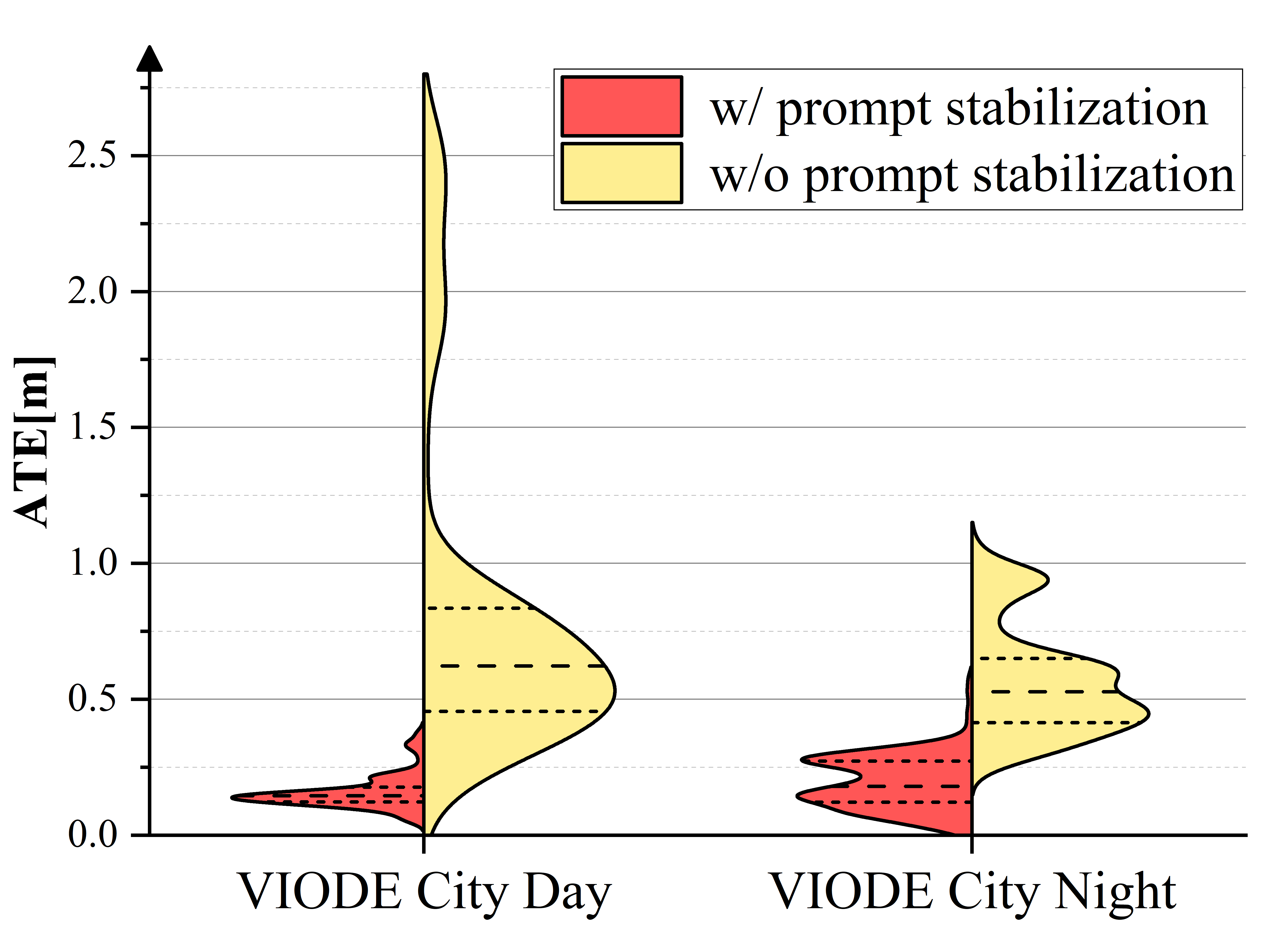
Prompt stabilization removes long-tail drift

The ablation study isolates each stage in STAG-VIO and shows that temporally stable prompts are the dominant factor behind robust dynamic-scene tracking.

VIODE keyframe filtering ablation result distribution
VIODE keyframe filtering ablation

Ablation · prompt stabilization

−83.28%
ATE RMSE, VIODE CITY DAY (−63.99% CITY NIGHT)

The gain is a systematic shift of the entire distribution, not a single statistic: median ATE drops 76.7%, the 95th percentile falls from 2.373 m to 0.326 m, and frames exceeding 1 m drop from 16.6% to 0% — with the interquartile range tightening 7.0× and standard deviation 9.5×. Prompt stabilization doesn't just lower average error; it eliminates the catastrophic drift episodes that populate the upper tail.

Experiments · Robustness

Stable localization under dynamic-object pressure

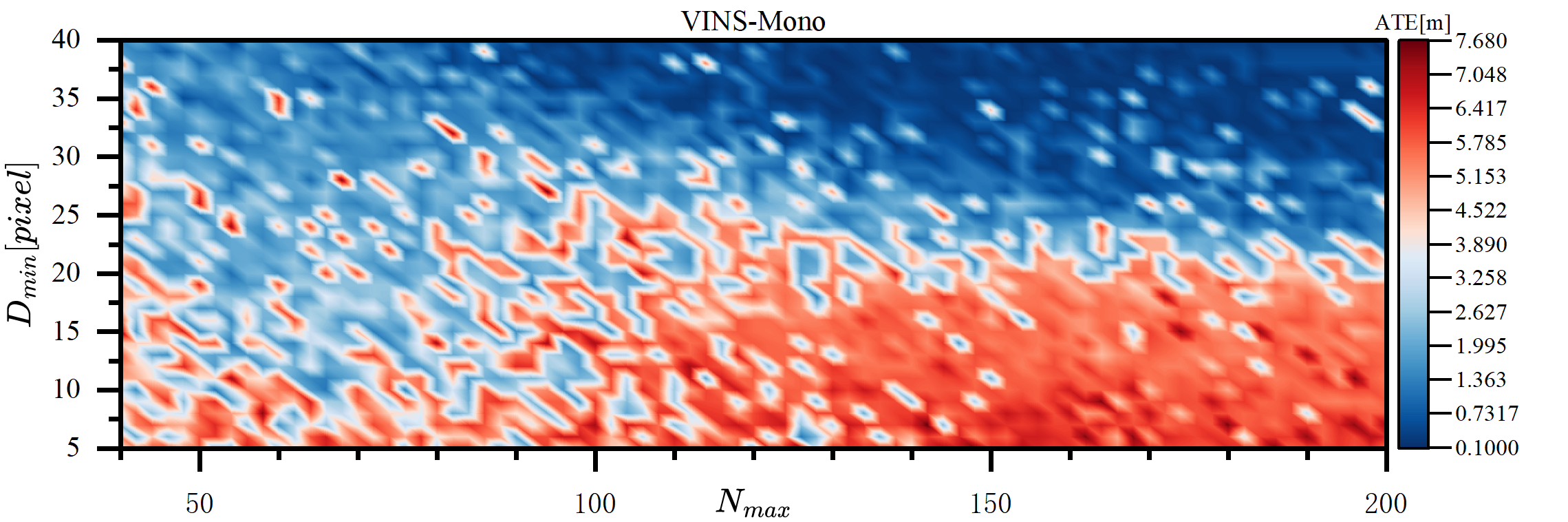
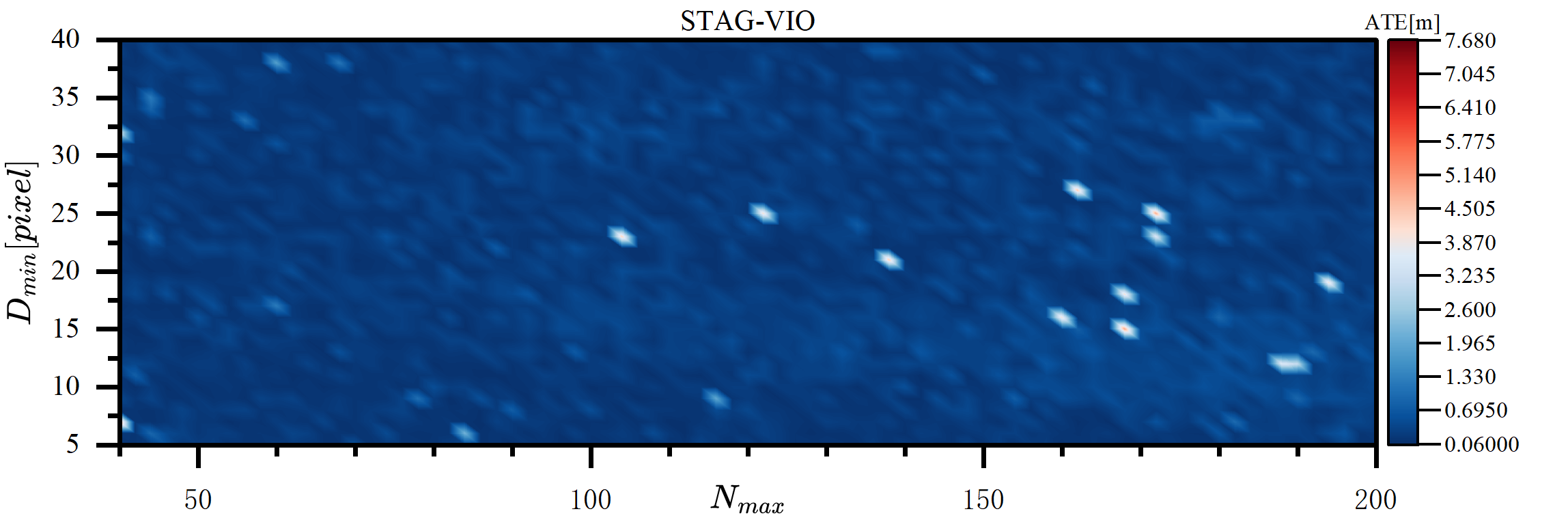
Heatmap comparisons visualize where dynamic objects repeatedly disturb feature selection and optimization. STAG-VIO suppresses unstable regions while preserving reliable static constraints for visual-inertial tracking.

VINS-Mono heatmap under dynamic-object interference
STAG-VIO heatmap under dynamic-object interference

Robustness · constraint budget

95.2%
OF 2,916 CONFIGURATIONS STAY BELOW 0.5 M — BASELINE: 13.6%

Densely sweeping Nmax ∈ [40, 200] and Dmin ∈ [5, 40] px, VINS-Mono spans 0.113–7.668 m with 78.9% of configurations exceeding 1 m — accuracy hinges on a well-tuned Dmin (ρ = −0.77). STAG-VIO holds a median of 0.229 m (10.2× lower) with a 25× tighter spread, essentially uncorrelated with both parameters: ANMS-based replenishment enforces spatial coverage internally, making nearly the entire parameter space deployable rather than a narrow sweet spot.

Real-World Deployment

From benchmarks to urban traffic

CameraIntel RealSense D435i · 1280×720 @ 30 Hz
IMUBMI085 @ 200 Hz
Ground TruthLivox Mid-360 + FAST-LIO2
CalibrationKalibr · camera–IMU extrinsics
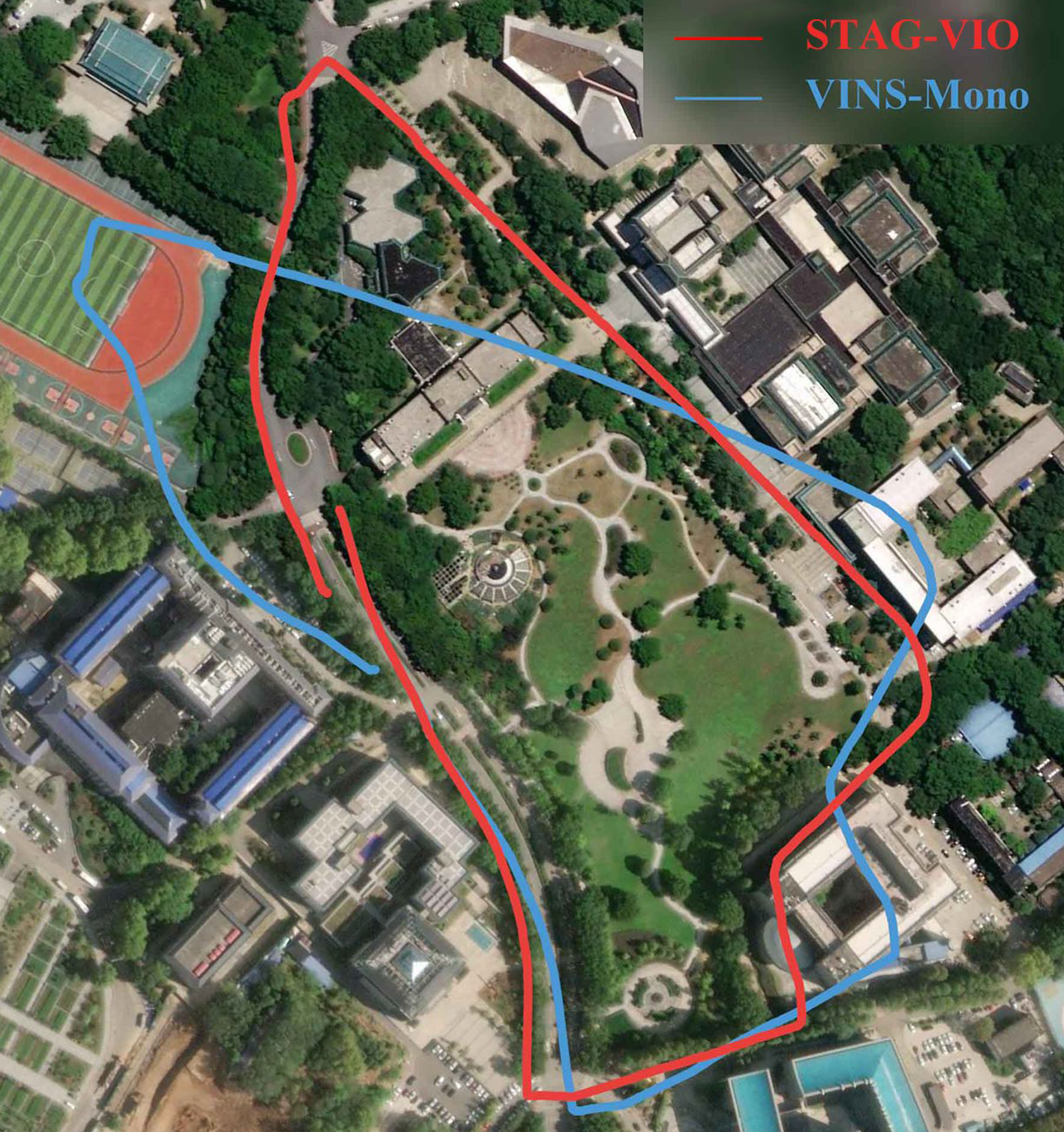
Real-world urban traffic experiment trajectory and error results
RMSE
VINS-Mono34.61 m
STAG-VIO14.56 m
↓57.9%
Mean
VINS-Mono29.27 m
STAG-VIO12.66 m
↓56.8%

Every statistic of the error distribution is roughly halved — not just the average. The maximum error drops from 75.21 m to 31.74 m and the standard deviation tightens by 61.0%, showing that STAG-VIO suppresses both steady drift and large occasional excursions. Qualitatively, VINS-Mono drifts visibly in segments with dense moving traffic, while STAG-VIO's trajectory conforms to the road geometry throughout the run.

THE SAME INTERFACE THAT WINS ON CONTROLLED BENCHMARKS TRANSFERS DIRECTLY TO UNCONTROLLED URBAN TRAFFIC.

Citation

BibTeX

@article{zhou2026stagvio,
  title   = {STAG-VIO: Stabilized Prompt-to-Geometry Interface for
             Robust Dynamic Visual-Inertial Odometry},
  author  = {Zhou, Rui and Liu, Jingbin and Xie, Junbin and Zhang, Jianyu
             and Hu, Yingze and Zhao, Jiele},
  journal = {arXiv preprint},
  year    = {2026}
}